



Hruby Symposium 2026
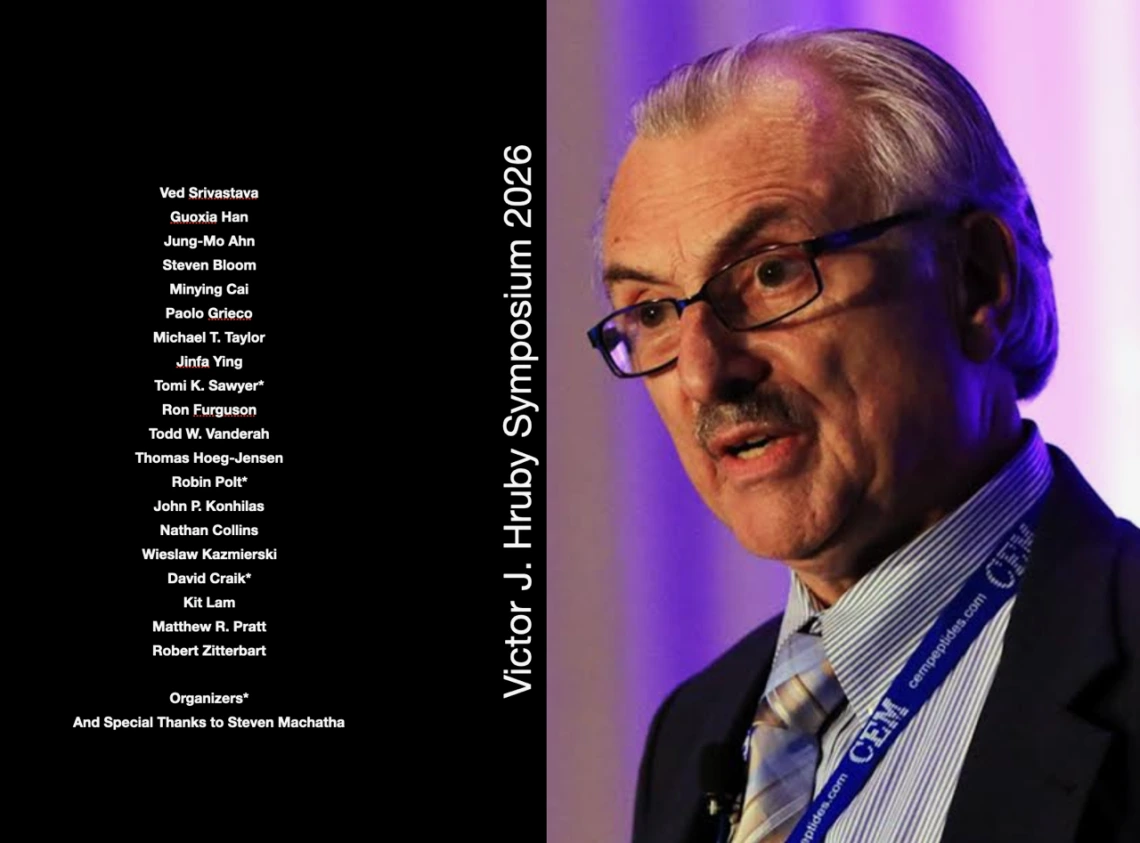
The inaugural Victor J. Hruby Symposium in May was a resounding success, drawing colleagues, students, alumni, and members of the broader scientific community to the University of Arizona for a celebration of one of the institution’s most distinguished scientists. Cosponsored by the Department of Chemistry & Biochemistry (CBC) and the Southern Arizona Section of the American Chemical Society (SAZACS), the symposium honored Victor J. Hruby, Regents’ Professor Emeritus, whose groundbreaking contributions have shaped peptide chemistry, chemical biology, and drug design for more than half a century.
Professor Hruby has long stood at the forefront of peptide science. Over a career spanning more than 50 years with more than 1,000 peer-reviewed publications, he has led pioneering advances in the design of receptor-specific peptide agonists and antagonists, particularly those targeting opiate receptors and melanocortin receptors. His work laid the molecular foundation for biochemical tools for research, as well as therapeutics that have reached the clinic, including Scenesse and peptide drugs developed by companies such as Palatin Technologies and Rhythm Pharmaceuticals. Equally important, his development of peptide libraries and bioactive analogues transformed how researchers design drugs and have accelerated discovery in both academia and industry.
The symposium celebrated not only Professor Hruby’s exceptional scientific accomplishments, but also his remarkable leadership and service to the global peptide community. As founding President of the American Peptide Society, Editor-in-Chief of both Peptide Research and the International Journal of Peptide and Protein Research, chair of the 8th American Peptide Symposium, and mentor to generations of scientists, Hruby has helped build and sustain the field in enduring ways. His influence can be measured by seminal discoveries, but also by the many former students, postdoctoral scholars, and collaborators who continue to advance peptide science around the world.
A particularly meaningful aspect of the event was its connection to the future. The symposium also served as a public kick-off for fundraising efforts at the University of Arizona in support of the Hruby Institute for Peptide Science, an initiative inspired by Professor Hruby’s legacy and vision. The Institute aims to strengthen the university’s leadership in peptide research by fostering innovation at the intersection of chemistry, biology, medicine, and translational science. Building on Arizona’s long-standing excellence in this area, the Hruby Institute for Peptide Science will help support the next generation of discovery, collaboration, and therapeutic development.
By celebrating Professor Hruby’s achievements while looking ahead to new opportunities, the symposium captured both the history and promise of peptide science at Arizona. It was a fitting tribute to a pioneering researcher, a generous mentor, and a global leader whose work continues to shape chemistry and medicine. The strong turnout and enthusiastic response made clear that Professor Hruby’s legacy remains a powerful force in the scientific community and that the future of peptide science at the University of Arizona is bright.
